
Artificial Intelligence (AI) presents a major opportunity for small and medium-sized enterprises (SMEs) in Quebec. By automating repetitive tasks, improving operational efficiency, and optimizing data analysis, AI enables more accurate decision-making. However, despite its benefits, adopting AI in SMEs remains a complex challenge.

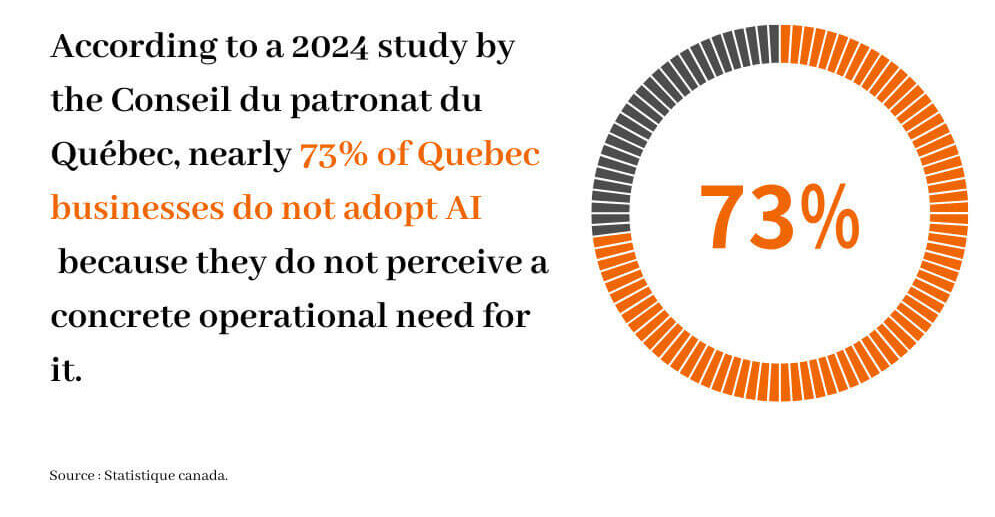
1. The Perceived Lack of Operational Need
Many SMEs hesitate to invest in artificial intelligence. They don’t clearly see how it could meet their current needs. This hesitation reveals a gap between the real benefits of AI and the ability to recognize them in the daily operations of SMEs.
Yet, AI is often already present in the company, without management even realizing it. For example, some employees informally use tools like ChatGPT, Copilot, or Grammarly to write, analyze, or automate tasks.
💡 This is precisely where an approach like AI 360 becomes useful: it maps internal processes and identifies relevant and realistic use cases for each SME.
2. Limited Resources Hinder AI Implementation in SMEs
One of the main barriers to AI adoption in SMEs is cost. Unlike large corporations with substantial digital transformation budgets, SMEs must operate within limited resources. Implementing AI solutions requires investment in software, hardware, training, and expertise.
Consider AI-as-a-Service (AIaaS) Solutions
These platforms offer access to AI tools via the cloud through flexible subscriptions. SMEs can experiment with AI at a lower cost, with scalable services that do not require significant capital investment. This allows for a gradual adoption aligned with their operational realities. These services eliminate the need to build in-house AI infrastructure. Instead, SMEs consume AI like any other cloud service, on demand. Some AIaaS solutions include: Microsoft Azure AI, Google Cloud AI, AWS AI Services, ChatGPT API/agents, Picture.
3. Resistance to Change and Corporate Culture
The introduction of AI can raise concerns among employees, particularly fears around automation and job loss. This resistance often delays technology adoption by leadership teams.
Solution: Take a Gradual Approach Involving Employees from the Start
Eficio’s AI 360 Journey approach is an effective way to build an AI roadmap that includes human and governance factors. Emphasize AI’s benefits, provide suitable training, and ensure transparent communication about objectives.
4. IIntegrating AI into SMEs: A Major Technical Challenge
Problem: SMEs often operate with heterogeneous, legacy, or custom-built IT systems that are incompatible with modern AI technologies. Integrating AI becomes complex, requiring significant effort to connect data sources, harmonize formats, or adapt business workflows. In some cases, a partial or complete infrastructure overhaul is necessary, increasing costs and the risk of operational disruption.
Solution: Assess the interoperability of AI solutions with existing technology environments upfront. It is recommended to choose modular, scalable tools compatible with open API standards. Cloud platforms (e.g., Azure, AWS, Google Cloud) often enable progressive integration thanks to native connectors and their ability to interface with existing ERP, CRM, or databases. This approach reduces technical complexity, supports incremental adoption, and avoids heavy transformation projects that SMEs may not be ready for.
5. Data Quality and Management
AI’s effectiveness depends on reliable, well-structured data. Yet many SMEs lack an effective data management strategy, which limits model training and prediction accuracy.
Solution: Establish Data Governance Before Adopting AI Automate data collection, clean/enrich datasets, and comply with current regulations, such as Quebec’s Law 25 on data protection.
6. The Lack of AI Expertise
AI expertise remains limited within SMEs. Hiring AI specialists can be expensive, and leaders are often unsure where to begin.
Solution: Invest in Internal Training, Partner with External Experts or Academic Institutions Government grants are available to support training and promote AI integration in businesses.
Conslusion
While artificial intelligence is a powerful growth driver for Quebec SMEs, its implementation is a complex process involving several challenges. By adopting a tailored strategy, investing in training, and choosing flexible solutions, SMEs can leverage AI to enhance their competitiveness without compromising financial or organizational stability. To support this transition confidently, our AI 360 approach offers a structured framework focused on real business needs and digital maturity.
Need help adopting AI? Contact us for personalized support.