

Artificial intelligence governance: organizational models and deployment strategies
Artificial intelligence is transforming the way we work, analyze, and make decisions. But beyond algorithms and technological promises, a key question arises: how can we effectively structure its governance? This article explores organizational models for AI governance, the key roles to be assigned, and best practices for making AI a true lever for sustainable transformation.

Why AI governance has become a strategic issue
The implementation of artificial intelligence in organizations is no longer limited to a one-off technological initiative. It now represents a lever for structural transformation, affecting processes, skills, culture, and business models. However, without clear and well-thought-out governance, these projects struggle to move beyond the pilot phase.
Artificial intelligence governance refers to all of the decision-making, organizational, and human mechanisms put in place to oversee, structure, and develop AI initiatives within an organization.
Three AI governance models: centralized, decentralized, or hybrid
1. Centralized model (hub)
This model brings together all AI skills (data science, engineering, data governance, modeling, etc.) within a center of excellence. The center acts as a strategic and technical driver for the entire organization.
Benefits :
- A comprehensive vision aligned with business objectives.
- Standardization of tools, methods, and processes.
- Pooling of rare and costly expertise.
Limits :
- Remoteness from operational issues.
- Less responsiveness to the specific needs of units.
2. Decentralized model (spoke)
In this model, AI expertise is directly integrated into business units, allowing for greater local autonomy and a better understanding of needs on the ground.
Benefits :
- Better adoption of AI tools by end users.
- Ability to tailor solutions to industry realities.
- Reduced silos between IT and business teams.
Limits :
- Risk of duplication of effort.
- Difficulty maintaining a consistent vision across the organization.
3. Hybrid model
The most common model today, the hybrid model combines the strengths of both approaches: a hub provides strategic coordination, governance, and skills development, while business units take charge of AI adoption and operational integration.
According to McKinsey, organizations that have structured a hybrid AI governance model (with a central hub and business units) achieve better results on a large scale.
Which functions fall under the hub, the units, or both?
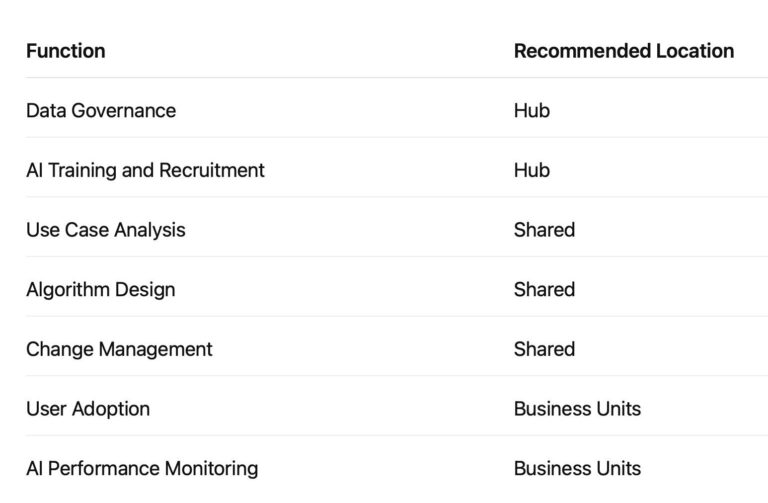
It is essential to clearly define responsibilities from the outset. However, there is still some gray area: certain tasks must evolve over time, depending on the level of AI maturity, organizational complexity, and the speed of innovation required.
Three key factors for choosing your AI governance model
1.The level of AI maturity
- If your organization is just starting out, centralization is often preferable for structuring the foundations (tools, methodologies, architecture).
- If you are more advanced, you can gradually transfer responsibilities to the business units.
2. The complexity of your structure
- The more divisions, markets, or geographies your organization has, the more essential a strong hub becomes to maintaining consistency.
3. The expected pace of innovation
- If your technological needs are changing rapidly, centralizing expertise allows for better anticipation and agile response.
AI governance: best practices for successful implementation
1. A coalition of cross-functional leaders
CIOs, CTOs, data managers, operations managers, business experts… All are involved in collaborative governance. This coalition ensures strategic alignment, resolves trade-offs, and creates lasting organizational momentum around AI.
2. Mixed project teams
Formed at the outset of an AI initiative, these teams bring together IT experts, business analysts, data engineers, UX specialists, and product managers. Their strength? A shared understanding of the challenges and rapid execution, with measurable impact.
Key points to remember when structuring artificial intelligence governance
✔Effective AI governance relies on a clear articulation of responsibilities.
✔ The organizational model must reflect the internal reality of the company (maturity, complexity, culture).
✔ Governance should not be rigid: it must evolve at the same pace as the organization.
✔Collaboration between IT, business, and strategy is essential to maximize the value of AI.
Take action: optimize your AI governance
Would you like to structure your artificial intelligence projects effectively? Our experts can help you choose the right organizational model and implement AI governance aligned with your business objectives.
👉 Book an exploratory meeting with an Eficio CIO
FAQ
What is artificial intelligence governance?
Artificial intelligence governance refers to the set of rules, processes, and organizational structures that govern the development, deployment, and use of AI in a company. It aims to ensure that AI is ethical, secure, effective, and aligned with business objectives.
Why is AI governance important for a company?
Good AI governance helps prevent abuses (ethical, legal, technical), optimize investments, ensure team buy-in, and maximize the value generated by artificial intelligence projects.
What is the best model for structuring AI governance?
There is no single model. The three main models—centralized, decentralized, and hybrid—must be chosen based on the company’s technological maturity, operational complexity, and capacity for innovation.
What are the key roles in artificial intelligence governance?
Key roles include the CIO, data scientists, product managers, data managers, and end users. Effective governance relies on close collaboration between business, IT, and analytics functions.
How can effective AI governance be implemented?
To structure effective AI governance, it is necessary to:
- define responsibilities (hub, units, or shared),
- establish an interdisciplinary steering committee,
- form mixed project teams,
- and adjust practices according to maturity and results obtained.